WHAT WE HAVE RECOVERED ABOUT NAMARIS
There are places remembered because they survived.
Others are remembered because they didn't.
Namaris appears to belong to the latter.
The name survives across scattered records from several Realms, although older material more commonly refers to the city as Ada Gor Namaris. Whether Namaris was originally the name of the city itself, the surrounding territory, or simply the shortened form favoured by travellers is unclear. Much of what might have answered that question disappeared alongside the place it described.
WISKER'S NOTE: I've actually been there. It still holds its charm. I have fond memories.
What surviving material does establish is that Ada Gor Namaris was once a city of considerable size. References to its markets, upper terraces, public courts, gates and trade districts appear frequently enough that they cannot reasonably be dismissed as later embellishment, while private correspondence recovered from the period suggests something far more valuable than scale alone.
People lived there.
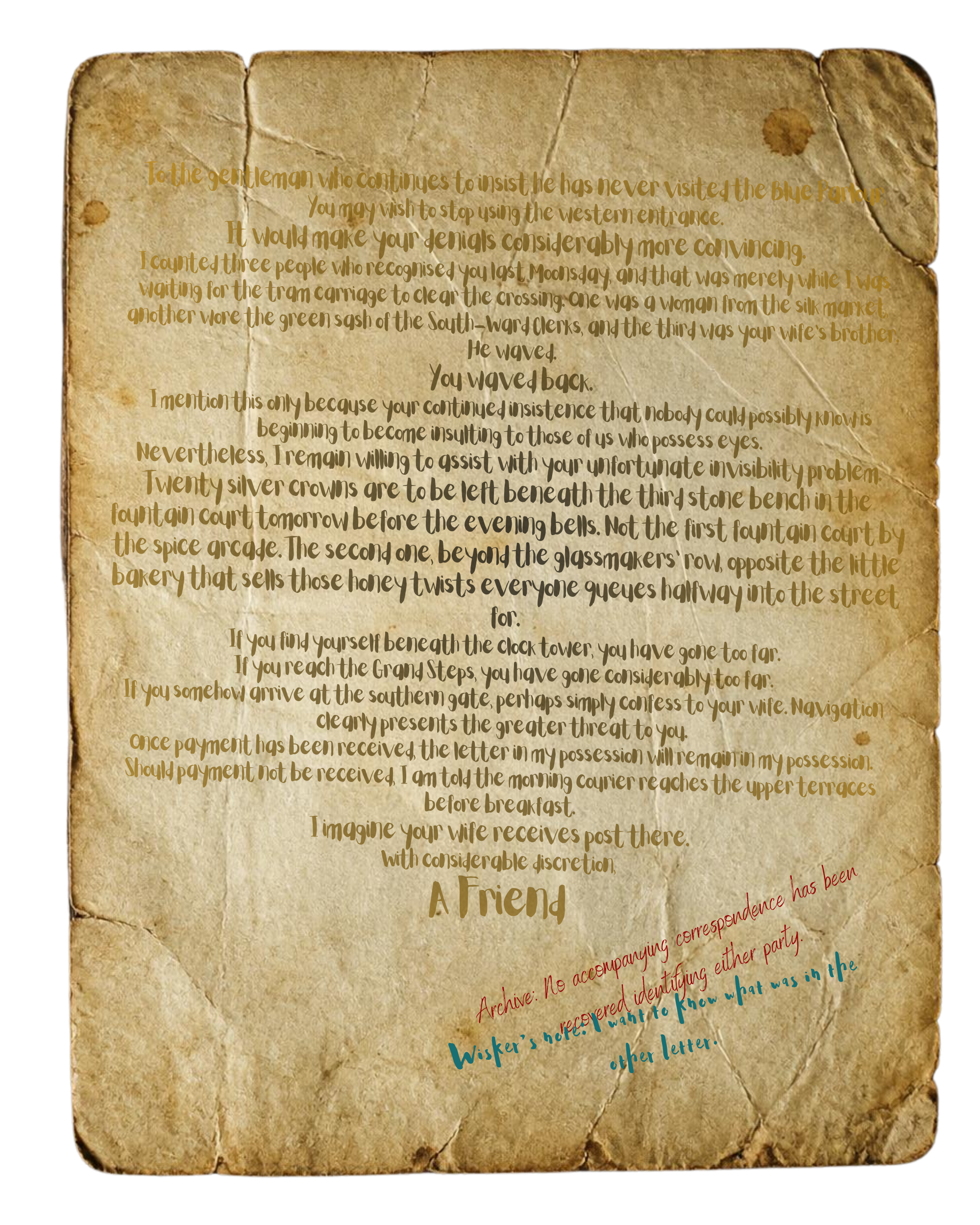
They worked, travelled, argued, traded, queued for food, sent letters, kept secrets and apparently blackmailed one another with sufficient regularity that at least one example survived.
Trade routes once ran directly to the city, carrying people and goods both into Namaris and outward towards neighbouring settlements and Realms. For a time, nothing in the surviving record suggests travellers considered the journey particularly unusual.
Then the routes began to fail.
All at once.
Records become inconsistent before they become frightening. Expected caravans failed to appear. Travellers altered familiar routes. Merchants complained of lost goods and missing couriers, while later notices increasingly advised avoiding roads that had previously been travelled without concern.
Trade with Ada Gor Namaris stopped. The city did not respond.
What happened afterwards is considerably more difficult to separate from folklore.
Some accounts claim a darkness settled over Namaris. Others describe the land surrounding it as changed, although descriptions of precisely how rarely agree. Stories collected much later insist that the city itself sank into the ground, its towers and streets swallowed beneath the earth until nothing remained above but a place nobody should enter.
There is no surviving contemporary record confirming that Ada Gor Namaris physically sank.
There are, however, remarkably few surviving records of anything that happened there afterwards.
WISKER'S NOTE: It did sink.
Later expeditions appear to have been attempted, although even these are difficult to reconstruct. Names survive in departure records. Supplies were purchased. Routes were planned. In several cases, correspondence confirms that groups knowingly travelled towards the region after Ada Gor Namaris had already disappeared from conventional trade.
No equivalent records of their return have been recovered.
It is from this period that descriptions of Namaris become darker. References to something beneath the earth begin appearing. Some accounts describe the city as dead. Others insist it remains there, buried but not abandoned, while increasingly superstitious sources claim that something took hold of Namaris and has never relinquished it.
Attempts to identify that something have produced little beyond contradiction.
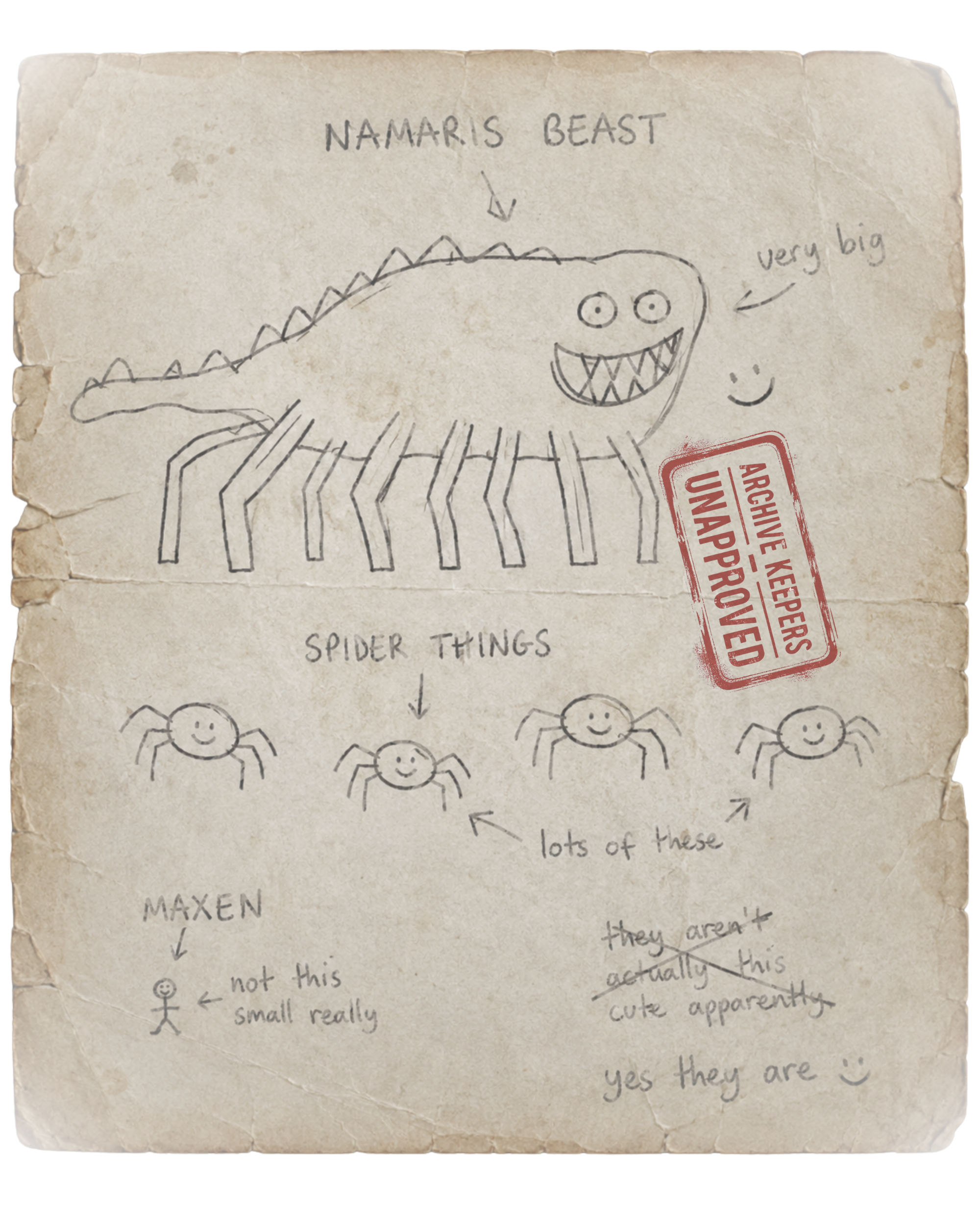
WISKER'S NOTE: There are things there.
ARCHIVE JO: What things?
WISKER: Namaris things.
Whatever happened, the distinction between the historical city and the Namaris spoken of today is considerable.
One was a destination. The other is a warning.
Yet enough remains to prove that before the abandoned routes, before the stories of darkness and before generations learned that travelling towards Namaris was considerably easier than travelling away from it, Ada Gor Namaris was not a cursed city beneath the earth.
It was simply someone's home.
We have recovered some of what they left behind.
WISKER'S NOTE: You should keep the blackmail letter.
ARCHIVE JO: It has already been catalogued.
WISKER: Good. I still think we'll find the other one.